
Canny Pricing 2026: Real Cost by Tracked Users ($948–$10K+)
Canny pricing explained for 2026: Free, Core, Pro, and Business by tracked users. Hidden costs at scale, plus FeatureOS flat-pricing comparison with real annual totals.
Look, Canny's pricing seems straightforward until you actually try to use it. They charge based on "tracked users" - which basically means every person who clicks, votes, or comments on your feedback board. The more people engage (which is literally the point), the more you pay.
Here's what it actually costs in 2026:
- Free Plan: $0 for 25 tracked users (no integrations, pretty limited)
- Core Plan: $228/year for 100+ tracked users (still no integrations or API)
- Pro Plan: $948/year for 100+ tracked users (this is where you get Jira, Slack, API)
- Business Plan: Custom pricing for 5,000+ tracked users (we've seen quotes from $5K to $10K+/year)
The catch? Most teams need the Pro plan ($948/year minimum) just to get basic stuff like Jira integration. That's fine if you have 100 users. But once your product takes off and you've got 1,000+ people engaging? You're pushed into Business pricing - often $5K–$8K/year. Not because you need more features. Just because more people are using what you already built.
It's backwards. You're paying more just because more people give real-time feedback. That's like your email tool charging you per recipient. It makes budgeting a nightmare.
Here's why this pricing model causes real problems (and what the alternative looks like).
Quick Pricing Reality Check (2026)
| Your Situation | What You'll Pay Canny | What You'll Pay Us | The Difference |
|---|---|---|---|
| Small team, basic needs | $228/year (Core - but it's pretty limited) | $600/year (Starter plan) | FeatureOS includes all core features |
| Growing team, need Jira/Slack integrations | $948/year (Pro plan) | $600/year (5 seats, Starter) | Save $348/year |
| Scaling up, 1,000+ engaged users | $5,000–$8,000/year (Business tier) | $1,200/year (10 seats, Growth) | Save $3,800–$6,800/year |
| Larger company, 5,000+ users | $10,000+/year (Custom quote) | $2,500/year (15 seats, Business) | Save $7,500+/year |
Real talk: Canny's Core plan is $228/year but missing integrations and API access. FeatureOS Starter starts at $600/year with unlimited users and all core features, plus a 30-day free trial. FeatureOS plans ($600-$2,500/year) are significantly cheaper than Canny at scale and include surveys, knowledge base, and AI features that Canny doesn't have at any tier.
See our full pricing breakdown
How Canny's Pricing Actually Works
Canny starts at $0, which sounds great. But here's how they get you: tracked users.
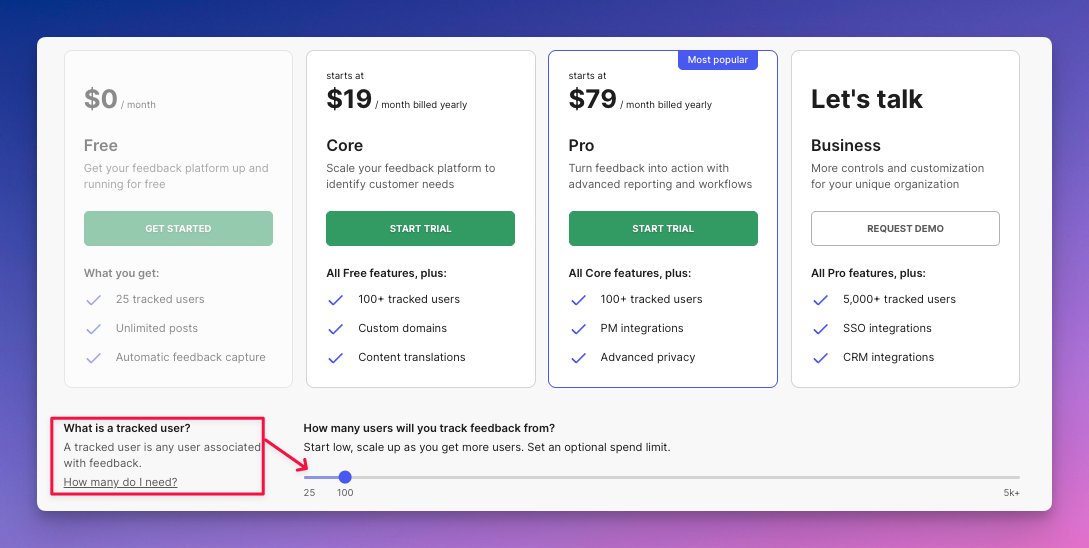
What's a "tracked user" anyway?
It's anyone who touches your feedback board. Post something? Tracked. Vote on a feature? Tracked. Leave a comment? Tracked. Even if someone just gets mentioned in feedback, they can count as tracked.
You get 25 for free. After that, every single person who interacts gets added to your usage total. Doesn't matter if they're a power user leaving detailed feedback or someone who clicked upvote once six months ago. They all count the same.
So if you launch a new feature and 100 customers vote on the next one, congrats - you just hit 100 tracked users and you're now paying for a plan. The more your product succeeds and people engage, the more you pay. Not for more features. Just... because.
It's not based on your team size or how actively you use the tool. It's based purely on external user engagement, which naturally grows as your product does.
Price of tracked users in Canny (2026 Pricing)
| Tracked Users | Plan | Annual Cost (20% off monthly) |
|---|---|---|
| 25 | Free | $0 |
| 100+ | Core | $228/year |
| 100+ | Pro | $948/year |
| 5,000+ | Business | Custom ($10K+ est) |
Note: Most teams need the Pro plan ($948/year) to get Jira integration, API access, and custom roles. Core plan is too limited for real use.
Your bill scales with user engagement, not value delivered. It's basically a tax on product success.
Compare with FeatureOS pricing
Why This Pricing Model Is Problematic
You're paying for noise, not signal
More feedback isn't always better feedback. But Canny charges you the same for a spam bot as they do for your most valuable customer. One-time commenters, fake accounts, people who voted once - they all count equally toward your usage.
We've talked to teams who realized they were paying for hundreds of "tracked users" that never engaged again after their first interaction. That's not a pricing model aligned with value. That's just charging for volume.
It makes budgeting impossible
Here's a fun scenario: you launch a new feature, send an email to customers asking for feedback, and suddenly 200 people engage with your board. Great for product development, terrible for your budget. You just doubled your Canny bill.
Or say you're running a growth campaign and onboarding more users. More users means more feedback, which means... a bigger bill. The pricing actively discourages you from doing things that help your product.
For finance teams trying to forecast SaaS costs, tracked-user pricing is a nightmare. It's driven by factors outside your control.
It charges for the wrong thing
Look, pricing should be based on what you're actually using - team seats, storage, API calls, whatever. Not on how many of your customers are engaged enough to leave feedback.
Imagine if Slack charged you per message received, or if your CRM charged per contact interaction. That'd be absurd. But that's essentially what tracked-user pricing does.
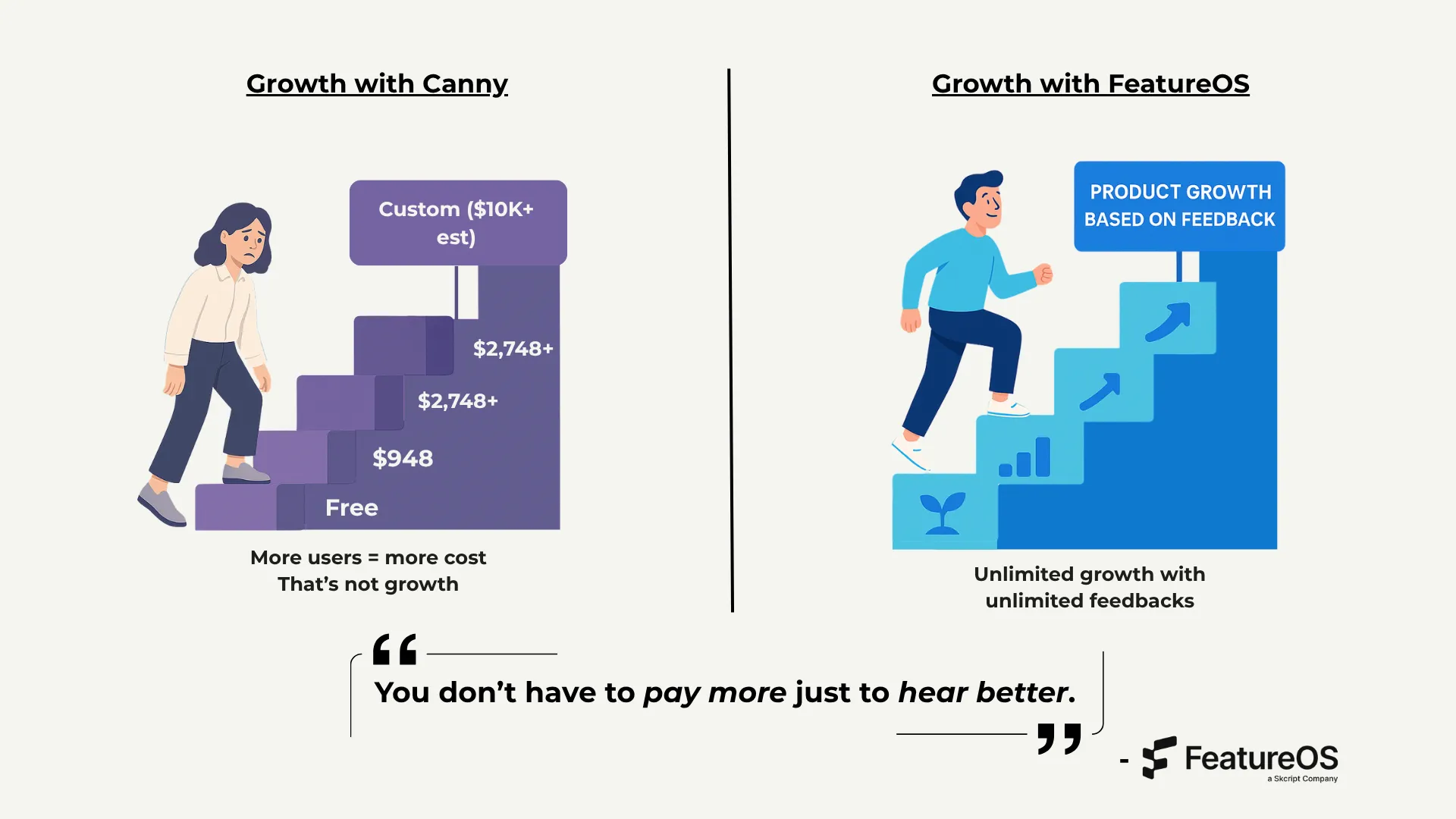
How FeatureOS Pricing Works (Full Disclosure)
We charge based on team seats and boards, not user engagement. Your customers can leave 10 pieces of feedback or 10,000 - price stays the same.
| What You Need | Canny | FeatureOS | Better Value |
|---|---|---|---|
| Free Plan | 25 tracked users, pretty limited | No free plan, 30-day free trial | Depends on needs |
| Try Before Buying | Same 25-user limit | 30-day trial, no limits | FeatureOS |
| Small Team Pricing | $228/year (Core) - no integrations | $600/year (Starter plan) | FeatureOS - more features included |
| Need Jira/Slack/API | $948/year (Pro plan) | $600/year (5 seats, Starter paid) | FeatureOS by $348 |
| Scaling to 1,000+ feedback users | $5K–$10K/year (Business tier) | $1,200/year (10 seats, Growth) | FeatureOS by $3.8K-$8.8K |
| Large teams, 5,000+ users | $10K+/year (Custom) | $2,500/year (15 seats, Business) | FeatureOS by $7.5K+ |
| What's Included | Feedback, Changelog, Roadmap | Feedback, Surveys, Changelog, Roadmap, Knowledge Base | FeatureOS (more modules) |
| AI Features | Autopilot for capture & deduplication | Sentiment analysis, keyword insights, clustering | Both have AI, different focus |
| How Pricing Works | Per tracked user (grows with engagement) | Per seat (grows with team) | Depends on your situation |
| Hidden Costs | Can spike unexpectedly with user growth | Only pay when you add seats/boards | FeatureOS (more predictable) |
What You Actually Get at Each Level
Canny tiers:
- Core ($228/year): Basic feedback + roadmap. No integrations or API.
- Pro ($948/year): Adds Jira, Linear, GitHub, API access. Most teams need this level.
- Business (Custom): SSO, CRM integrations. Required if you hit 5,000+ tracked users.
FeatureOS tiers:
- Starter ($600/year): All modules (feedback, surveys, roadmaps, changelog, knowledge base), unlimited users, all core features. Includes 5 seats and integrations like Jira/Slack. 30-day free trial available.
- Growth ($1,200/year): 10 seats, everything in Starter plus SSO, API access, white-labeling, priority support.
- Business ($2,500/year): 15 seats, unlimited boards, everything plus dedicated CSM, advanced integrations, custom contracts.
Main difference: We include surveys, knowledge base, and AI analysis from day one. With Canny at $948/year, you get feedback and integrations but still need separate tools for surveys and docs.
How the unlimited user thing works
You pay for team seats (people on your internal team), not tracked users (your customers). So if 50 people or 50,000 people leave feedback, your bill is the same. Add another PM or support person? That's +$15/month.
This means your costs scale with your team growth, which you can plan for. Not with user engagement spikes, which you can't.
What's not included (honesty time)
We don't have Canny's Autopilot feature that automatically pulls feedback from support tickets and other channels. If you need cross-platform automated ingestion, that's one thing Canny does better. We're working on it, but it's not there yet.
Also, we don't have a free plan (though we offer a 30-day free trial), so if you're a solo founder just starting out and need a permanently free option, Canny's free tier might work initially.
Let's Run the Numbers
Imagine you're a growing SaaS with:
- 1,000+ users actively leaving feedback
- 10-person product team (PMs, engineers, support folks who need access)
- You need Jira integration and API access
What Canny would cost: Start with Pro plan at $948/year for 100+ tracked users. But 1,000 engaged users pushes you into Business pricing. Based on what we've seen from teams who've shared their quotes, that's usually $5K–$8K/year. Plus, you'll see spikes when you launch new features or run campaigns that drive engagement.
What we'd cost: Growth plan at $1,200/year for 10 seats. Doesn't matter if 100 users or 10,000 users engage - same price. Includes surveys, knowledge base, roadmaps, and changelog.
So yeah, difference of $3,800–$6,800/year in this scenario. Your mileage may vary based on your actual tracked user count with Canny.
The Other Tools You'll Need
Canny does feedback boards really well. But it's not a complete solution, so you'll probably need:
Stuff Canny doesn't do:
- In-app surveys and forms (add Typeform or SurveyMonkey: $300-$600/year)
- Knowledge base or docs (add Notion or GitBook: $200-$500/year)
- AI sentiment analysis (Canny has Autopilot but not sentiment/keyword clustering)
- Unified survey-to-roadmap workflow (disconnected tools)
For a broader comparison of tools that handle the full feedback loop, check our guide to the 9 best customer feedback management tools.
So if you go with Canny Pro at $948/year, plus survey and docs tools, you're looking at $1,500–$2,000+/year total. And you're juggling multiple platforms.
With us, it's one platform. Feedback, surveys, roadmaps, changelog, knowledge base, and AI analysis. $600-$2,500/year depending on team size, with a 30-day free trial. Not saying our approach is objectively better - some teams prefer best-of-breed tools over all-in-one. Just depends what you value more: integration or specialization.
So Which Should You Choose?
Honestly, it depends on your situation:
Canny makes sense if:
- You're early stage with less than 100 engaged users
- You want a specialized tool that does one thing (feedback) really well
- You like their Autopilot feature for auto-ingesting feedback from other channels
- You're okay managing multiple tools for surveys and docs
We make sense if:
- You want to try before you buy with a 30-day free trial and unlimited users
- You have 100+ engaged users (you'll save significant money on paid tiers)
- You want everything in one place (feedback, surveys, roadmaps, docs)
- You need predictable pricing that doesn't spike with engagement
- Your team is growing and you want seat-based pricing
Neither is objectively "better" - it's about fit. We built FeatureOS because we kept seeing teams get burned by unpredictable pricing models. If that resonates, try us for 30 days. No credit card needed.
Need Help Deciding?
If you're comparing options and want someone to walk through your specific situation, we're happy to help. We can show you:
- What your actual Canny costs would be based on your user count
- What you'd pay with us for your team size
- Whether the feature trade-offs matter for your workflow
Even if we're not the right fit, we'll tell you. Email hello@featureos.com with your details or schedule a quick call.
Related Resources
Frequently Asked Questions
Everything you need to know
Canny's pricing starts at $0 for their Free plan (limited to 25 tracked users), $228/year for Core, $948/year for Pro, and custom pricing (typically $5K-$10K+/year) for their Business plan. Most teams need the Pro plan at $948/year to access integrations like Jira, Slack, and API access.
A tracked user is anyone who interacts with your Canny feedback board. Posting feedback, voting on a feature, leaving a comment, or even being mentioned in feedback can count you as a tracked user. Every person who engages gets added to your usage total, regardless of how active they are.
Canny's pricing scales with user engagement, not team size. As more customers vote, comment, and submit feedback, your tracked user count grows and pushes you into higher pricing tiers. Teams with 1,000+ engaged users are typically quoted $5K-$8K/year on the Business tier, even if they do not need additional features.
FeatureOS charges based on team seats instead of tracked users, which means your costs stay predictable regardless of how many customers engage. FeatureOS also includes surveys, knowledge base, and AI analysis alongside feedback boards, while Canny requires separate tools for those functions. Teams switching from Canny typically save 60% or more on annual costs.
Yes, Canny offers a free plan, but it is limited to 25 tracked users with no integrations or API access. FeatureOS offers a 30-day free trial with unlimited users and all core features including feedback boards, roadmaps, changelog, and knowledge base. Paid plans start at $60/month.
Canny focuses on feedback boards, changelog, and roadmaps. It does not include in-app surveys, knowledge base or documentation, or AI sentiment analysis. Teams using Canny often need additional tools like Typeform ($300-$600/year) for surveys and Notion or GitBook ($200-$500/year) for documentation, adding $500-$1,100/year to the total cost.